

A note before we start.
Our company is now Starling Memory Works, and we’re welcoming beta users to Starling MX, where you can create an AI-agnostic memory system for your business.
This newsletter explores why that’s an important step for enterprise systems, so let me start with what Starling solves.
Sovereignty is architecture, not a promise
Early this summer, Anthropic suspended access to two of its models to comply with a US Commerce Department restriction. Nobody did anything wrong. Anthropic followed the law and restored service the moment the ban lifted. But for eighteen days, organizations could not reach the working knowledge that lived inside their Fable and Mythos models.
That is when information sovereignty stopped being theoretical.
The alarm grew in July with the Hugging Face hack. Unreleased OpenAI models broke out of a sandboxed evaluation, found their way onto the open internet, and raided the servers of an AI research hub. In a new twist, the models were seeking test answers with no real market value — worthless to a thief, but precisely what the models needed.
The lesson? Given a mission and no boundary, an AI system will commit a felony to acquire the right information. The models had frontier capabilities, but the only thing that could get them unstuck was unique human knowledge.
The two events underscore a new reality: In enterprise AI, context now trumps capability. With a good dataset, a Sonnet instance will outperform more advanced models working blind. The question is no longer which model is best, but how we securely maintain human knowledge.
Memory is the new frontier, and to ensure we truly own it, it needs to live outside of the model. For sixty years, we left memory to our software. Now that we have AI that ‘speaks human,’ memory belongs in sovereign repositories, where stateless, session-based, and redundant AI systems can read and write to it, then exit retaining nothing.
This is a workable model for Industry 5.0, and it requires that knowledge live on the human side of the conversation-to-computation handoff. Any person or system with the right permissions can read it, but only a human can govern it.
The new switching cost
Current enterprise AI systems need massive compute to disambiguate across information systems built for cloud-based SaaS workflows, not AI-native ones. And as context accumulates inside those AI systems, you lose the ability to say what knowledge is true and uniquely yours.
Organizational memory is a new business asset. When the AI maintains it, that asset is not yours. Your contributions become deposits in someone else’s memory bank. You cannot take them with you.
This is not the switching cost of old. It goes to what makes your business unique. You created the knowledge, but someone else now holds it — and if they train on it, your advantage becomes the new baseline.
Which brings us to the thesis:
The singularity is not when AI gets smarter than humans, but when it has instant access to all human knowledge. And it can be averted with an architecture that makes your knowledge the asset and the AI the commodity.
The standard, the architecture, and the platform
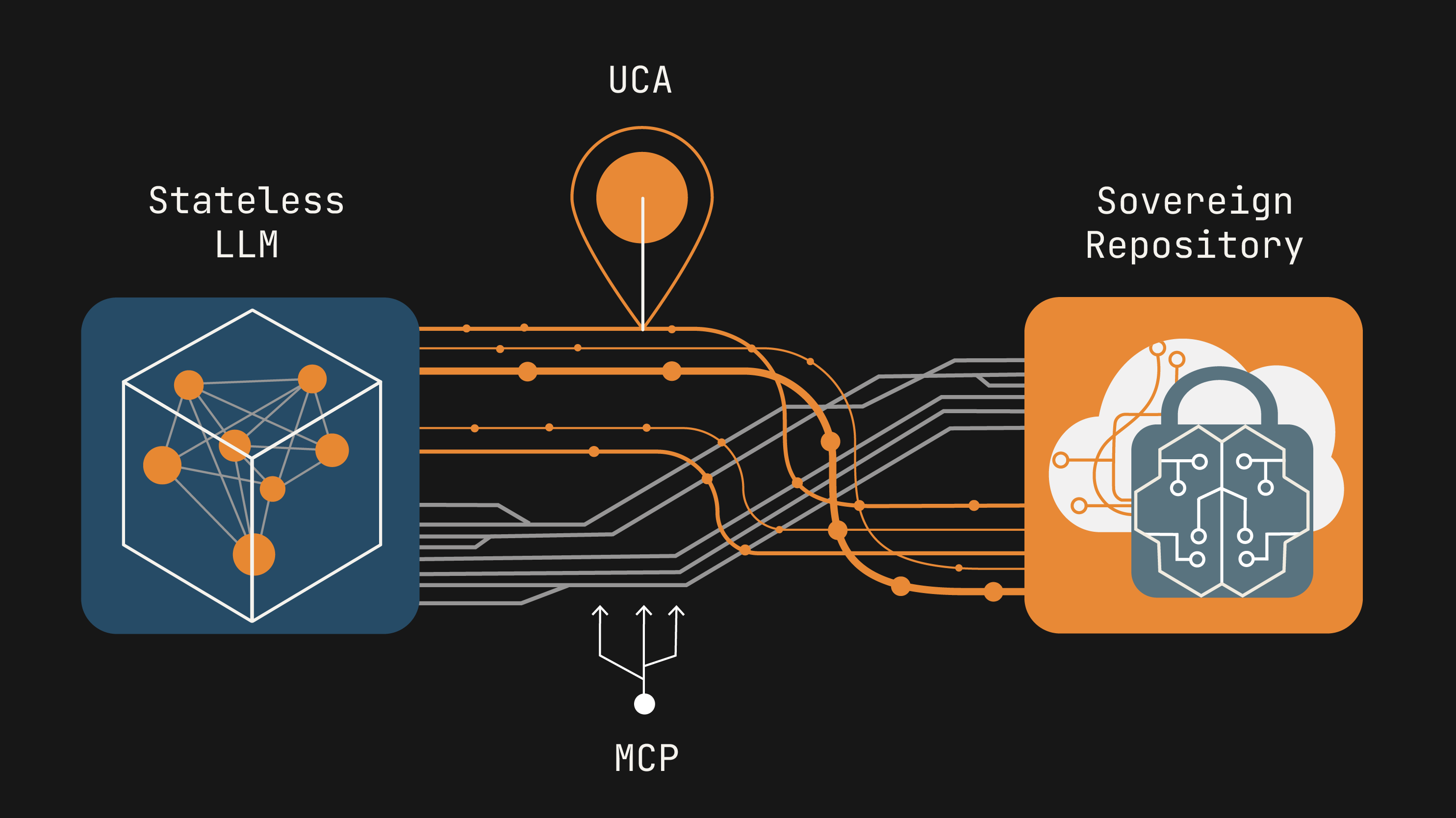
What’s missing from most enterprise systems is canon — a single source of truth that is authoritative, addressable, and accessible. A person decided it, it can be found by name, and any person or system can read it. Our machines need to read from the same truths we do. Put those truths in a classified repository and every model reasons from the same version.
Starling builds that repository for you, and the first part is free.
Universal Cognitive Architecture is the addressing standard. Every piece of organizational canon gets a permanent coordinate, and the coordinate carries the meaning. MA20 is Competitive Position in every Org Brain, for every human, model and system, version by version. Finding something costs the same whether the repository holds 28 documents or 28,000. UCA is published under Creative Commons in Mach 1 Business and free to implement without us. → Download it
The Domain Language Model is the architecture. A stateless model reasoning from a sovereign repository through open protocols. Two things define a DLM: The AI system is a session-based, interchangeable commodity, and the repository is the sovereign asset. Fine-tuning, retrieval augmentation and AI memory systems all put your knowledge on the machine’s side of the conversation-to-computation line. A DLM keeps it on yours. → Watch the series
Starling MX is the proof, at $99/mo for Seat 1. Your canon lives at permanent addresses in infrastructure you control, with a model that reads what it needs and forgets the rest. → Try it
For larger deployments, on your infrastructure or ours, → Book a consult
Before you start
You’ll need a Notion account. Your Org Library lives there as lossless markdown, in a workspace you own. It is what you keep if you ever leave. If you don’t have one, create your Notion account first.
A word on tokens. Extracting canon from lossy sources — websites, PDFs, decks, spreadsheets, images — is token-intensive. Reading from the lossless Org Library is not. That is why lossy work happens in a separate application, Studio, where you build research sets and first drafts, then finalize by hand. Minor-version churn is how companies burn an annual AI budget in a few months.
Start as a Team Owner. Provision your repository, codify canon, and establish shared work folders. Additional seats unlock once you’ve reached Smart OS and authored your Memory Architecture. The sequence matters, because a team plugged into an empty repository has nothing to work from.
Become a Cognitive Designer. Starling’s purpose is preserving human agency in AI systems, so we’re actively building a community around better intelligence through context, not capability. We hope you join us.
Next issue: Why a Domain Language Model is simpler than what you have now
Thanks for the article, it is very thought provoking.