

A note before we start.
Universal Cognitive Architecture’s release was picked up last week by IT Brief, Research Live, and other outlets. This is the addressing system underneath everything we build, released for anyone to implement without us. It’s free, under Creative Commons, in Mach 1 Business.
What a DLM actually is
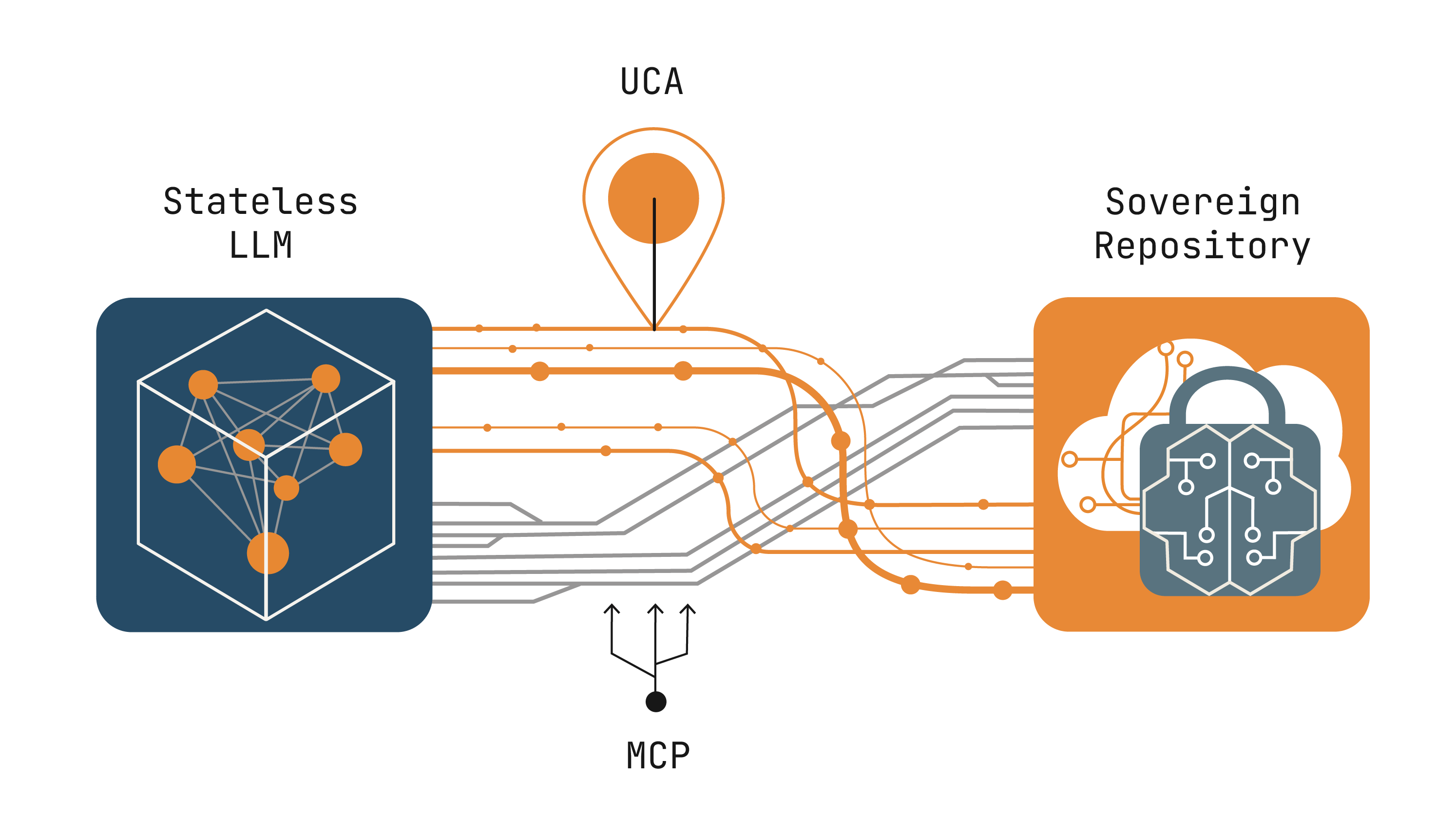
Last week, we introduced the Domain Language Model, which we define as stateless, session-based, and redundant AI systems that read and write to a sovereign memory repository. There are four components:
A stateless AI System (with no retention capabilities),
Model Context Protocol (Anthropic’s open pipeline),
Universal Cognitive Architecture (our open classification system), and
A Sovereign Repository (the curated dataset every business now needs).
In a DLM, the AI system is an interchangeable commodity, and the repository is the sovereign asset. Your knowledge sits in plain-text markdown at permanent addresses, and any model with permission can read what it needs, reason from it, and exit retaining nothing.
It doesn’t need to store knowledge. The next instance can pick up where it left off.
Here’s what that means: Information sovereignty is a performance upgrade, not a defensive trade-off — in our testing, a mid-tier model reasoning from well-governed memory outperforms a frontier model working blind.
Our memory is better than the AI Labs’ for a simple reason — because it injects their models with context. The DLM does not replace the language model, or compete with it, or ask you to trade capability for control. It adds the one thing the model cannot infer. Human-governed knowledge.
Ready to build your portable, AI-agnostic memory system? → Try Starling MX.
What it costs to find out
Before the mechanics, here is the candid version of the offer. We’ve logged over 7,000 code hours making Starling enterprise-grade, but that’s not why to plug in.
Starling is month to month, and $99 buys Seat 1. In your first month, you build your Constitutional Memory and have Starling author your memory architecture on top of it — at permanent addresses, in a Notion workspace you own.
Starling’s First Fifteen are worth the price of admission all on their own. Adapted from decades of business frameworks, they establish a baseline intelligence so viable, Starling can extrapolate the rest of your memory architecture from it.
And if you cancel once you’ve created your Memory Architecture, point Claude to that Notion workspace and keep working. That’s the exit test from last week, priced. One month to build your universal set, and it works without us.
Simpler, and better, by a long way
Compare what else gets your organization’s knowledge in front of an AI.
Fine-tuning means paying to bake your knowledge into a model’s weights. It’s expensive, static the moment it finishes, and results in your knowledge living inside someone else’s model.
Retrieval augmentation means a vector database, chunking strategy, embedding model, and similarity search that returns passages that are approximately relevant. It works, sort of. But you are maintaining a second system whose job is guessing what you meant.
Vendor memory features mean the AI remembers your conversations. Convenient, and the accumulation, again, belongs to the vendor.
All three put your knowledge on the machine’s side of the conversation-to-computation line. A DLM keeps it on yours, and needs less machinery to do it. Because here is the thing about a well-classified repository: You don’t need to guess what is relevant if everything has an address.
How context reaches the model
A DLM uses two open protocols, doing two different jobs:
Model Context Protocol is the pipeline. It gives an AI system access to your knowledge on demand. MCP makes information sovereignty possible.
Universal Cognitive Architecture is the coordinate system. Every piece of organizational canon gets a permanent address, and the address carries the meaning. UCA makes sovereignty scalable.
Think of it as the difference between a library with a card catalog and one without. Access is not the same as findability.
For every request, Starling scores its own confidence in the context it has assembled. Below the threshold, it asks for more information. Above it, it consults the manifest — a catalog of your business’s memory — and then pulls exactly what it needs.
Which means retrieval is a lookup rather than a search. A card catalog you consult costs less than a librarian who reads every shelf.
Where your tokens actually go
Here’s what I wish someone had told me two years ago: Reading memory is cheap. Conversion is expensive.
Every time an AI system turns a PDF, deck, spreadsheet, or scanned document into something it can reason from — and every time it turns reasoning back into one of those formats — you pay for the translation. Do it constantly and you will consume an annual AI budget in a matter of months. Most organizations have no idea this is where the money goes. We itemize it.
We started by splitting the two jobs into two places:
Your Org Library is the lossless repository. Plain markdown, permanent addresses, in a workspace you own. Reading from it costs little because there is nothing to parse.
Studio is the lossy repository and conversion surface. Source material comes in, brand assets and style rules get applied, finished documents go out. That is where the expensive work happens, deliberately fenced off from the memory that drives decisions.
This Dual Repository helps eliminate the single biggest avoidable AI cost, which we call minor-version churn. It means asking for ten iterations of the same document, with the model rebuilding from scratch each time. Our delivery system resolves to an inline editor, so a person can make the last changes by hand, for free.
So, here’s a fair question to ask yourself: How many AI-initiated documents does your company produce in a month, and how many of them are the nth draft of something?
Here’s how it works
An Owner establishes the Org Library, and onboarding produces the First Fifteen — the constitutional memories every business needs on the record. Mature companies can do this in an hour or two through web and document extraction. Earlier-stage companies experience an accelerator process that designs an AI-native business in natural conversation.
At fifteen, Smart OS activates and Starling switches from Builder to Chief of Staff. It now has enough of your logic to help design the standards and protocols that make you distinct, the active work folders where teams collaborate, and the patterns that accumulate across campaigns and departments.
Now you’re ready to invite your team, with day-to-day work moving to three main interfaces:
Your team’s day begins on Surface — a daily brief and a kanban for the work in front of you. It’s an ongoing, continually compacting thread with a bird’s-eye-view of all your work.
Strategy happens in Workspace, where context is assembled and new memory is authored. Each thread is an individual session, creating specs, messaging, revenue models, etc.
Conversions are handed to Studio, where PDFs and Office documents are created and edited inline, and AI-assisted HTML pages are designed. This is the token-intensive work, isolated on purpose.
It’s an AI-native workflow, where memory only becomes lossy at the conversion point, when documents are imported or exported.
Starling’s self-serve Smart Office tier caters to teams of up to 50, with managed hosting. For larger organizations, our Smart Enterprise tier hosts the repository on your infrastructure or ours.
What you get
Your AI stops guessing about your business. Surface picks up not only where your last work left off, but where the rest of your team’s did.
AI-agnostic workflows. Use Sonnet for daily work, Opus for conversion, Gemini for analysis, GPT for voice. Enterprise customers can select from 100s of models.
High compliance governance. We are currently building Org Brains for a pipeline that includes pharmaceutical and financial services, two of the most regulated industries there are.
Token transparency. Memory is separated from output, so you can see which model burned tokens, on what task, and whether it was worth it.
You stop betting on a vendor. Whatever ships next, your memory is already in a format it can read. Lock-in stops being a question you have to have an opinion about.
We built Starling this way ourselves. Our engineering team ran the entire platform build through a single semantic address — SY50 Platform Master — with scores of subfolders and hundreds of artifacts beneath it. The classification system scales because we made it carry a complex project before we asked anyone else to.
And here’s the twist
Every memory you create is written in human language, not machine code. You don’t need a developer to implement it, and there’s no schema to learn. If you can read, you can build on it, and so can any model you point at it.
That’s the simplicity the DLM promises. Sixty years of leaving memory to our software systems, and it turns out that once you have AI that speaks human, the answer looks more like a library than a database.
Starling’s purpose is preserving human agency in AI systems. We are building a community of Cognitive Designers around better intelligence through context, not capability. I hope you’ll join us.
→ Build your first memory node
Free and open: Universal Cognitive Architecture under Creative Commons · What canon needs, the video series · For deployments across divisions or in regulated environments, talk to us about enterprise.
Find us on LinkedIn, Instagram, and YouTube.
Next issue: What an Org Brain knows that your org chart doesn’t